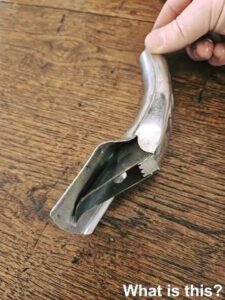
Years ago, my father handed me a small, unusual metal tool with a hollow handle. He never explained what it was used for, and whenever I asked him about it, he would simply smile or laugh without giving me an answer. At first, I thought it was just some forgotten household gadget, so I placed it in my toolbox and eventually stopped thinking about it. Several years later, while going through my old tools, I came across it again. Curious to finally discover its purpose, I tried to figure out how it worked. I even considered whether it might be some kind of lever, scraper, or prying tool, but none of those possibilities seemed quite right. Eventually, I decided to show it to an older family friend who had spent years working with traditional tools and mechanical equipment. The moment he saw it, he recognized it immediately. It was an old-fashioned oil can opener, a practical little device that mechanics once used to puncture sealed metal motor oil cans so the contents could be poured out. Before modern packaging and convenient pouring spouts became common, tools like this played an important role in everyday garage work. The hollow handle and unusual shape suddenly made perfect sense. What I had considered a strange and almost useless piece of metal was actually a clever invention designed to solve a common problem from another time. It was fascinating to discover how something so ordinary could hold such an interesting history. Looking back, I also began to appreciate why my father had kept the tool and passed it down to me without explaining its purpose. Perhaps he wanted me to discover its story for myself. Sometimes, the smallest forgotten objects can teach us something about the past and remind us how much everyday life has changed. What once seemed completely mysterious turned out to be a useful piece of history worth keeping.