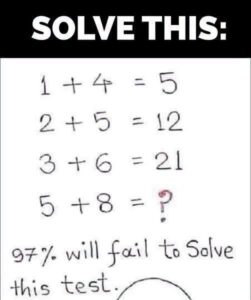
Some math puzzles are challenging not because they involve complicated calculations, but because their solutions depend on spotting a hidden pattern. This particular number puzzle looks simple at first, yet it has left plenty of people questioning their mathematical skills. Take a look at the following equations: 1 + 4 = 5, 2 + 5 = 12, 3 + 6 = 21, 5 + 8 = ?
Although the equations appear to involve basic addition, the results suggest that another mathematical rule is being followed. One popular explanation is to add the previous answer to the two numbers in the next equation. The first calculation gives 5, the second becomes 2 + 5 + 5 = 12, and the third follows the same rule: 3 + 6 + 12 = 21. Applying this pattern to the final equation gives 5 + 8 + 21 = 34.
However, 34 isn’t the only answer people have suggested. Depending on the mathematical relationship chosen, other interpretations can produce different results, including 45. That’s what makes number-pattern puzzles so interesting: without a clearly stated rule, more than one mathematical explanation may be possible.
The real challenge isn’t simply finding a number that fits. It’s discovering a consistent rule that explains every equation. So, before looking at the suggested solution, take another moment to study the sequence and see whether you can uncover the hidden relationship.
What did you get: 34, 45, or a completely different answer? Share your solution and explain the rule behind it in the comments!